Age is Just a Number: How Two Masters Athletes Over 65 Master ‘Physiology First’ in the VQ Velocity Virtual Studio
In my live VQ Velocity virtual studio, I use this peer-reviewed science to deliver bio-individualized coaching within a live group setting. Two of my studio riders, Jeff and Ken (both over 65), recently demonstrated how real-time bio-telemetry and live micro-coaching allow masters cyclists to push past perceived limits without overreaching. Ken’s achievement is particularly extraordinary: three years ago, he suffered a major heart attack and underwent a triple bypass. Today, guided by autonomic data rather than blind wattage targets, he is safely driving his cardiorespiratory system into high-adaptation zones.
1. Setting Target Prescriptions in Physiology First Cycling Coaching
Before my riders log into VQ Velocity at 5:00 AM, I send them custom target breakdowns based on their personal autonomic profiles. I don’t tell them to blindly hold a static wattage; I prescribe the exact internal response we are hunting.
Prescribed Target Profiles Sent Pre-Ride:
- Jeff’s Prescription: Drive Detrended Fluctuation Analysis (α1) via Garmin Connect IQ down from threshold (0.50) to 0.35–0.45, push ventilation to 42–45+ breaths per minute, and elevate heart rate to 135–142+ bpm across three sustained work blocks.
- Ken’s Prescription: Execute 6-minute mixed intervals (3 minutes at Threshold, 3 minutes stepping up to VO2max). The goal was to smoothly step up power, driving DFA α1 down to the 0.45–0.55 threshold range while ventilation reached 38–44+ brpm.
2. Live VQ Velocity Studio Coaching: Micro-Coaching the Internal Signals
During a live VQ Velocity workout, I don’t just shout generic motivation or stare at an ergometer grid. I actively orchestrate an internal physiological event, coaching each athlete individually while maintaining group energy:
- Calling Out the VT2 Inflection Point (DFA α1 = 0.50):
“Alright Jeff, smooth pedal stroke, keep your cadence right at 88 rpm. Watch that AlphaHRV field on your Garmin. As you settle into 195 Watts, tell me when your blue line drops through 0.50. That’s your anaerobic threshold—your body is switching gears right now!”
- Hunting the Severe Stimulus Zone (DFA α1 ≤ 0.40):
“Ken, you’re at minute 4 of your step-up. Don’t worry if the wattage fluctuates by 5 watts—focus on your breathing! I want to see that Respiratory Rate tick past 40 breaths per minute. Drive that alpha-1 down toward 0.45 and hold it steady!”
- Gauging Time Spent in Stimulus & Lowest Value Achieved:
“How low did it drop? Call out your numbers! Jeff, did you hit 0.35? How many seconds did you stay under 0.40? That time spent below 0.40 is where your heart and lungs are being forced to adapt!”
3. Telemetry Validation for Physiology First Cycling Coaching
Following the workout, we open the raw telemetry from their .fit files to validate our live studio work against FirstBeat Analytics engine algorithms. Both athletes achieved monumental physiological strain, proving that internal biological effort drives fitness adaptations—not arbitrary wattage numbers.
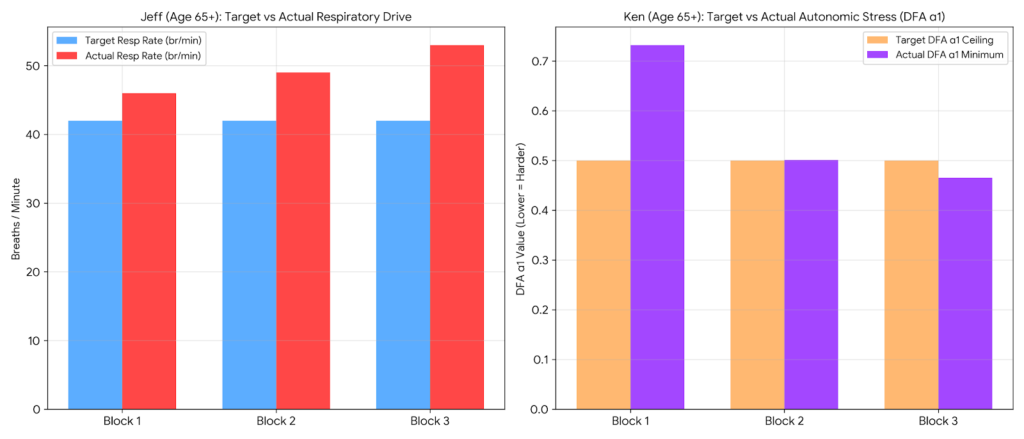
Jeff (Age 65+): Overachieving the Respiratory & Autonomic Signal
Jeff was initially hesitant to push into higher intensity, but tracking his live telemetry in the studio gave him the confidence to cross the threshold boundary.
| Work Phase | Target Wattage | Actual Avg Power | Target Resp Rate | Actual Peak Resp Rate | Target DFA α1 | Actual Min DFA α1 | Result |
|---|---|---|---|---|---|---|---|
| Block 1 | 190–210 W | 162 W | 42–45 brpm | 46 brpm | 0.35–0.45 | 0.18 | Target Achieved |
| Block 2 | 190–210 W | 175 W | 42–45 brpm | 49 brpm | 0.35–0.45 | 0.24 | Target Achieved |
| Block 3 | 190–210 W | 170 W | 42–45 brpm | 53 brpm | 0.35–0.45 | 0.20 | Target Achieved |
The Takeaway: Jeff produced slightly lower average wattage (162–175 W) than predicted, but his internal response was off the charts. His ventilation soared to 53 brpm, and his DFA α1 dropped to 0.18, confirming total autonomic breakdown and a 100% successful high-intensity training stimulus.
Ken (Age 65+): Precision Training After Heart Attack & Triple Bypass
Given Ken’s cardiac history, guiding his training via real-time autonomic stress (DFA α1) and respiratory rate in the virtual studio ensures he receives maximum central cardiovascular stimulus without subjecting his body to dangerous overexertion.
| Work Phase (Min 3–6) | Target Wattage | Actual Avg Power | Target HR | Actual Peak HR | Target DFA α1 | Actual Min DFA α1 | Target Resp Rate | Actual Peak Resp Rate |
|---|---|---|---|---|---|---|---|---|
| Set 1 | 195–215 W | 150 W | 142–150 bpm | 147 bpm | 0.45–0.55 | 0.732 | 38–44 brpm | 40 brpm |
| Set 2 | 195–215 W | 153 W | 142–150 bpm | 151 bpm | 0.45–0.55 | 0.501 | 38–44 brpm | 43 brpm |
| Set 3 | 195–215 W | 148 W | 142–150 bpm | 154 bpm | 0.45–0.55 | 0.465 | 38–44 brpm | 41 brpm |
The Takeaway: Ken held smooth, controlled power outputs (~150 W) and progressively accumulated severe physiological strain. By Set 3, his heart rate hit 154 bpm, his respiration rate reached 41 brpm, and his DFA α1 dropped to 0.465. He successfully crossed his anaerobic threshold (VT2) safely and predictably, demonstrating remarkable cardiac recovery three years post-bypass.
Why Masters Athletes Choose Physiology First Cycling Coaching
When athletes log into my VQ Velocity studio and experience individualized, bio-telemetry coaching inside a group workout, they realize they are receiving elite-level care backed by the Garmin Connect Ecosystem and peer-reviewed science.
It takes the anxiety out of hard workouts. My riders know they aren’t guessing or overreaching blindly; they are executing precision physiology under direct supervision. By watching their real-time ventilation and DFA α1, these 65+ athletes know exactly when they have hit the adaptation zone, allowing them to train smarter, recover better, and continuously build performance at any age.
I’m the only coach in the world who is melding the powerful metrics of the Garmin Ecosystem with Group Fitness Programs. This is available LIVE, 5-6 days a week. Classes roll at 0500 PST.

Garmin Products are the most advanced sport and fitness metrics in the history of the world. But there’s a gap between the DATA they provide, and the KNOWLEDGE we can gain from this information. If you’ve got questions, I’ve got answers. Sign up for a consult, and let’s look at your data together. No AI necessary! 🙂