Tracking my sleep isn’t just about how long I was “out”; it’s about what my Autonomic Nervous System (ANS) was doing while the lights were off. As a coach who preaches Physiology First, the Garmin Sleep-Time Stress metric is one of the most honest looks into my recovery.
Let’s break down the data from my last 10 nights to see why that “Average 19” matters more than I used to think.
The Science of Garmin Sleep-Time Stress
Garmin isn’t measuring how “stressed” I feel mentally; it’s measuring Heart Rate Variability (HRV). To understand this, I always say:
“HRV translates into the happiness of the heart. When a heart beats IRREGULARLY at the millisecond level, it’s happy. When the heart is forced to beat MORE REGULARLY, it’s under duress. A happy heart beats when it WANTS TO. A stressed heart beats BECAUSE IT HAS TO.”
For more on the technical side of HRV, you can check out how Garmin stress tracking works and how it compares to other metrics like Digital Trends’ accuracy tests.
Analyzing My Garmin Sleep-Time Stress Numbers
Garmin uses a 0–100 scale. For me, the “line in the sand” for Garmin Sleep-Time Stress is 25.
- 0–25 (Rest): This is my goal. If I am in the blue, I am actively recharging my Body Battery.
- 25–50 (Low Stress): I see orange bars here. It’s not a “crisis,” but it means my recovery is on hold while my body deals with a specific load.
10-Night Trends in Garmin Sleep-Time Stress
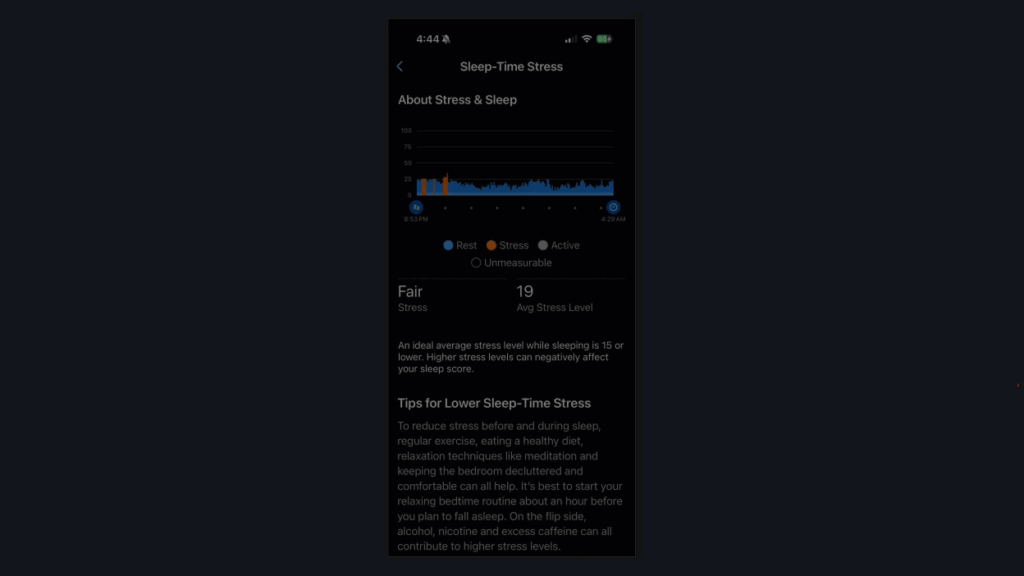
Looking at my data across these 10 separate nights, I see a remarkably consistent “Physiological Signature.” While the numbers fluctuate slightly—ranging from an Average Stress of 16 to 24—I consistently stay under that 25-point threshold for the majority of the night.
The “Early Night” Spike: Why Timing Matters
In almost all of my data, there is a distinct orange block at the start of the night followed by a sea of blue. This is a common point of discussion in the community, often seen when a stress score is high during sleep on Reddit.
- Late Fueling: If I eat a large meal close to bed, my heart beats “because it has to” process those nutrients.
- The “Hard Start” Hangover: If I did a late-afternoon interval session, my core temperature and metabolic rate are still elevated when my head hits the pillow.
- The Shift: The most important part of my data is the transition. No matter how I start, my system eventually settles into the blue.
How Garmin Sleep-Time Stress Impacts Body Battery
The Garmin Sleep-Time Stress value is the “recharge rate” for my Body Battery. If my stress is 15, I might see a +80 recharge; at 25, that same 8 hours of sleep might only give me a +50 recharge. Check out the official Garmin explanation for more on the Body Battery tie-in.
I think of it as the quality of the electricity going into my battery. High stress is “dirty power”—it takes me longer to get the same amount of juice. This is why I can sleep for 9 hours and still wake up feeling like I “missed a spot” in my recovery.
The “Garmin Guru” Verdict
My 10-night trend is the definition of Functional Overreaching—I am working hard enough to see some sympathetic activity at night, but I am recovered enough to drop back into the “Blue Zone” for the majority of the night.
Guru Tip: To turn my “Fair” scores into “Excellent,” I need to look at those first 90 minutes. If I can shift that early orange block to blue by cooling the room or moving dinner an hour earlier, my recovery efficiency will skyrocket.