Forget Your Software’s Threshold: Your Physiology Rewrites the Rules in Real Time
We’ve all been conditioned to treat our threshold like a monument carved in stone. Your bike computer, your smartwatch, or your coaching software gives you a single, static number—say, a functional threshold power (FTP) of 250W or a threshold heart rate of 162 bpm—and you anchor your entire training identity to it.
But yesterday’s ride exposed the massive flaw in that logic. In a Physiology-First training model, threshold isn’t a fixed destination calculated weeks ago; it is a dynamic threshold dictated by your cells right now.
Yesterday morning, I rolled out the door at 4:58 AM. My pre-ride fueling consisted entirely of two cups of coffee with a splash of milk—effectively a fasting state. To make matters worse, I miscalculated my on-the-bike bottle, mixing 5 scoops of NBS Carbo-Hydration for a 50 g/hr intake instead of my targeted 60 g/hr.
On paper, my software thought I was executing a standard threshold interval. In reality, my real-time biometrics from my ride file, Richard Long Threshold Interval.csv, proved that my dynamic threshold had completely collapsed from the combined weight of pre-ride fasting and on-the-bike under-fueling, forcing me to overpay catastrophically for every single watt.
The Pre-Ride Black Hole: Rolling Out Empty at 5:00 AM
Before looking at the interval data, we have to look at the liver. When you wake up for a 5:00 AM session, your liver glycogen stores are already depleted from supporting your brain and organs overnight. By skipping pre-ride carbohydrates and relying solely on caffeine, I forced my body to start the engine with zero exogenous glucose floating in the bloodstream.
When you start an intense threshold effort with depleted liver glycogen and then short-change your on-the-bike bottle by 10 grams per hour, your physiology faces a compounding crisis. Your body has to work drastically harder just to find the fuel required to hit your targets. If you’ve read my previous coaching data breakdowns, you know how quickly an empty tank ruins a session.
The Math: How a Small Miss Became a Big Problem
The label on NBS Carbo‑Hydration is clear:
- 2.5 scoops = 25 g carbs
- 1 scoop = 10 g carbs
I drank 5 scoops, which means: 50 g carbs total (200 calories), leaving me exactly 10 g/hr short of my 60 g/hr target.
On paper, 10 grams doesn’t look like much. But physiologically, especially in Reno heat and during long aerobic work, that gap matters completely.
The First Signs: Feeling Flat
About 40 minutes in, right as the threshold interval block was scheduled to begin, I felt that unmistakable “flatness”:
- Power felt sticky
- Breathing felt slightly heavier
- HR drifted upward
- PerfCon hesitated to stabilize
These are classic signs of mild under-fueling—your body still has gas in the tank, but the metabolic cost of maintaining stability is higher than it should be.
Your Dynamic Threshold Voltmeter: Performance Condition
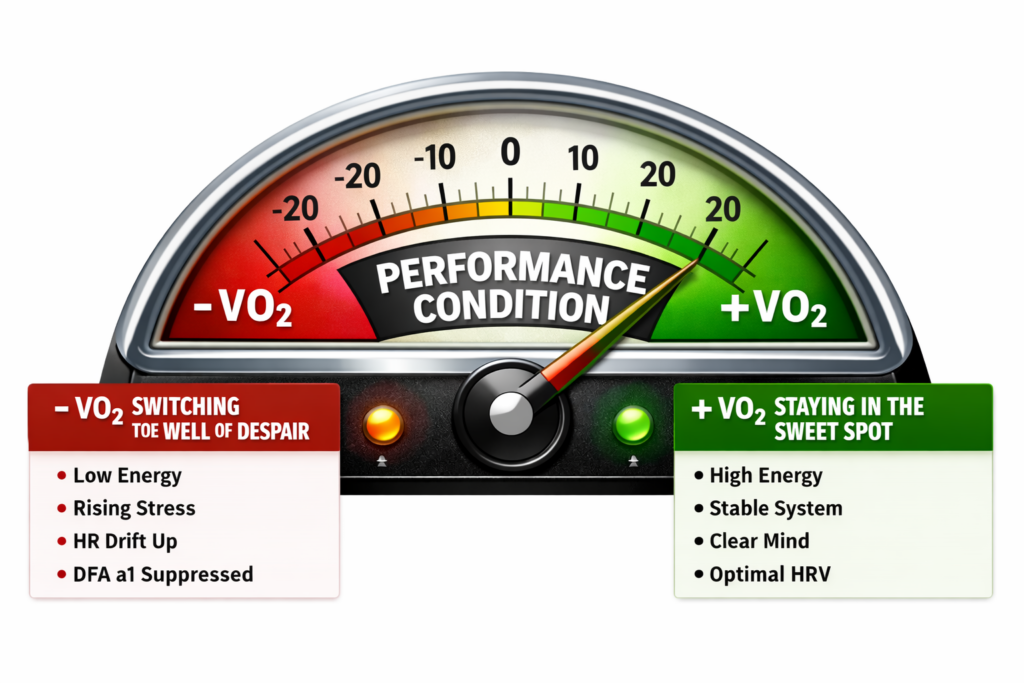
Think of Garmin’s Performance Condition (PerfCon) like a real-time physiological voltmeter. When that meter is positive, it means your system is stable, you’re running on clean internal voltage, and you have the physiological headroom (+VO2) to handle the workload. When it ticks into the negative, your system is drawing from a deficit (-VO2), short-circuiting your efficiency, and dragging you straight into the “well of despair.”
During this 63-minute ride, my voltmeter spent 36.8 minutes running a negative voltage. The second I dropped into the interval at minute 40, my software’s predefined “threshold power” of 229.5W became an absolute physiological tax, and the voltmeter pinned itself between -1.0 and -2.0.
The score wasn’t a random calculation; it was an exact mathematical real-time receipt of how a compromised dynamic threshold creates underlying biometric chaos:
- The Under-Fueling Deficit: A clear 10g carb/hr shortage combined with a fasting 5:00 AM start meant zero blood glucose availability.
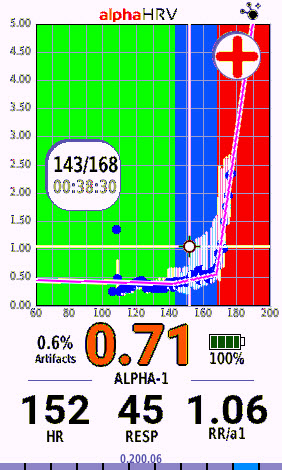
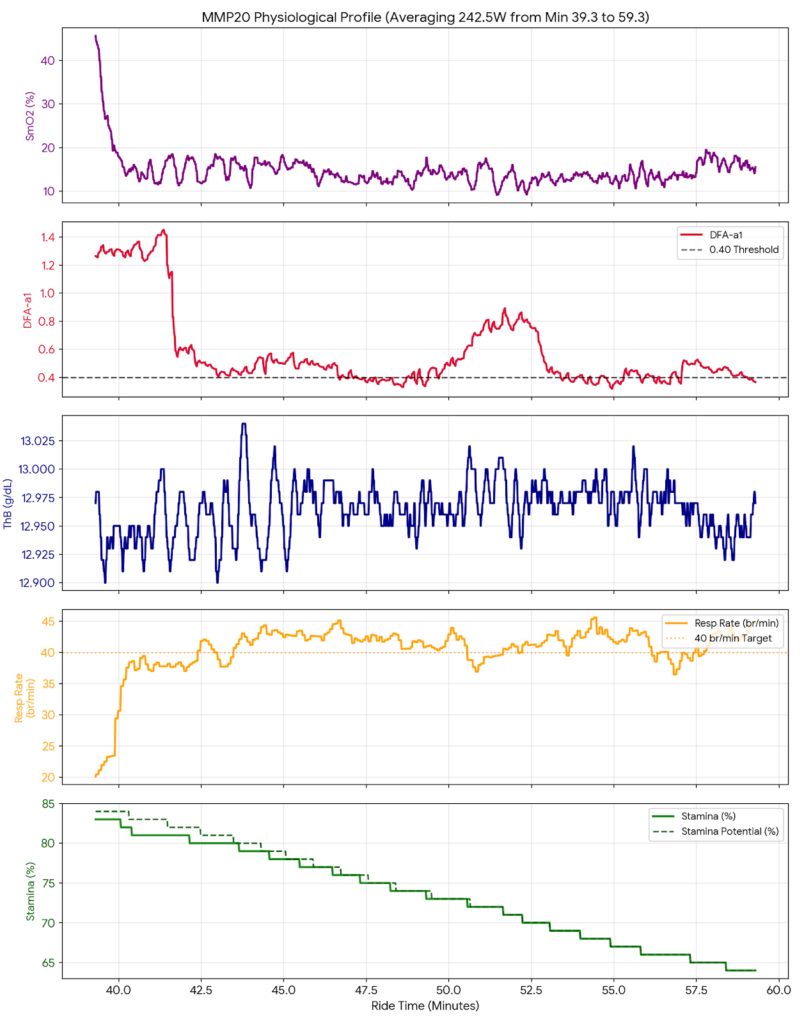
- The Autonomic Collapse (DFA-α1 Below 0.4): My DFA-α1 plummeted right at minute 40, spending 7 minutes and 55 seconds completely submerged below 0.40, hitting an absolute floor of 0.261. This signaled profound sympathetic dominance—my nervous system was in a full “fight-or-flight” panic to maintain output.
- The Respiratory Skyrocket: My respiration rate exploded to an average of 41.4 breaths per minute, peaking at a gasping 47.5 breaths per minute.
- Local Muscle Suffocation: Monitored by my Moxy sensor on my left quad, my muscle oxygenation (SmO2) flatlined at a miserable average of 15.5% during the interval, scraping a bottom of 9.1%. Because I lacked carbohydrate efficiency, my system aggressively drained its local reserves—a scenario heavily tied to how we understand and evaluate a rider’s anaerobic capacity as a cyclist under heavy glycolytic strain.
- Cardiovascular Creep: My heart rate continually slipped upward, spending 172 seconds pinned above 170 bpm and maxing out at 174 bpm as adrenaline took over to force the legs to turn.
Why Under-Fueling Hits DFA-α1 So Hard
Carbohydrate availability directly influences autonomic balance. To put that DFA-α1 data into perspective, look at how the nervous system shifts strain:
- 1.0+ → Stable, low strain, aerobic coherence
- 0.75–0.50 → Rising strain, approaching VT1
- 0.50–0.40 → Autonomic stress accumulating
- <0.40 → Sympathetic dominance, metabolic instability
When DFA-α1 sits below 0.4 for long stretches, it’s telling you: Your autonomic system is overloaded, your metabolic cost is too high, you’re burning through stability faster than you can replenish it, and you’re drifting into “fight to maintain output” mode.
And that’s exactly what happened. My DFA-α1 didn’t just dip—it stayed suppressed, which is the signature of under-fueling combined with environmental stress. DFA-α1 is a powerful real-time fueling indicator because it doesn’t care what your bottle says. It cares what your cells are experiencing.
The Cascade: How 10 Grams Became a Systemic Drift
Here’s the exact physiological chain reaction that unfolded on the trail:
Under-fueling → Reduced carbohydrate availability → Increased reliance on fat oxidation → Higher oxygen cost per watt → Elevated respiration rate → Autonomic strain → DFA-α1 suppression → Performance Condition instability → “Flat” feeling and rising HR drift
This is why even small fueling errors matter. They don’t just affect energy—they slam your autonomic stability, respiratory efficiency, and overall metabolic coherence.
The Dynamic Correction: What the Numbers Should Be
My legs possess an incredibly resilient oxygen extraction capability; I know I can comfortably sustain a deep muscular compression trench of 13% to 17% SmO2 for 30 minutes. Furthermore, an aggressive, highly functional threshold respiration rate for me sits right around 40 breaths per minute.
But look at the contrast between my under-fueled breakdown and a stable, fueled threshold. Without carbohydrates to back up those numbers, my system lacked the baseline support to handle the strain, shifting my actual dynamic threshold down and turning a functional threshold block into systemic exhaustion:
| Metric | Yesterday’s Deficit Interval (Actual) | True Sustainable Threshold (Ideal) |
|---|---|---|
| Performance Condition | Pinned at -1.0 to -2.0 (Dipping into the well of despair) | ≥ 0 (+VO2 Stable voltage, clear physiological headroom) |
| Heart Rate | Slipping into 171–174 bpm (Adrenaline spike) | Stabilized at 160–164 bpm (Cardiovascular equilibrium) |
| DFA-α1 | Crashed to 0.26–0.35 (Autonomic chaos) | Hovering steadily between 0.40–0.45 (True threshold ceiling) |
| Respiration Rate | 41.4 to 47.5 breaths/min (Hyperventilation) | Controlled plateau at 38–40 breaths/min (High-efficiency drive) |
| Muscle Oxygenation (SmO2) | Crushed at 9%–15% (Unsupported local exhaustion) | Stable floor at 13%–17% with systemic baseline balance |
Listen to the Cells, Not the Screen
Yesterday’s ride proved that your static “software threshold” is a ghost. If you trace your training purely by the numbers on a screen without looking at your pre-ride nutrition and internal load, you are guessing.
My bike computer said I was riding at threshold. My physiology recorded a system-wide crisis before the interval even started because I rolled out on empty at 5:00 AM. Knowing your numbers is why I build customized physiology-first coaching programs for athletes who are tired of guessing.
The Fix: Precision Fueling for Stability
To hit your targets cleanly and keep your voltmeter in the positive, you cannot shortcut the baseline:
- 60 g/hr → 6 scoops of NBS Carbo-Hydration minimum.
- Wake up the liver: Always consume easily accessible carbohydrates before stepping over a bike frame at 5:00 AM.
When you fuel incorrectly, your dynamic threshold drops, and your internal voltmeter ticks straight into the negative. Protect your physiology, keep your on-the-bike bottle precise, and let your physiology tell you where your true threshold lives today.
Tired of letting static software metrics wreck your training? Let’s decode your true internal biometrics together.