
Xert Focus is one of the F.I.T.T. Variables When Training
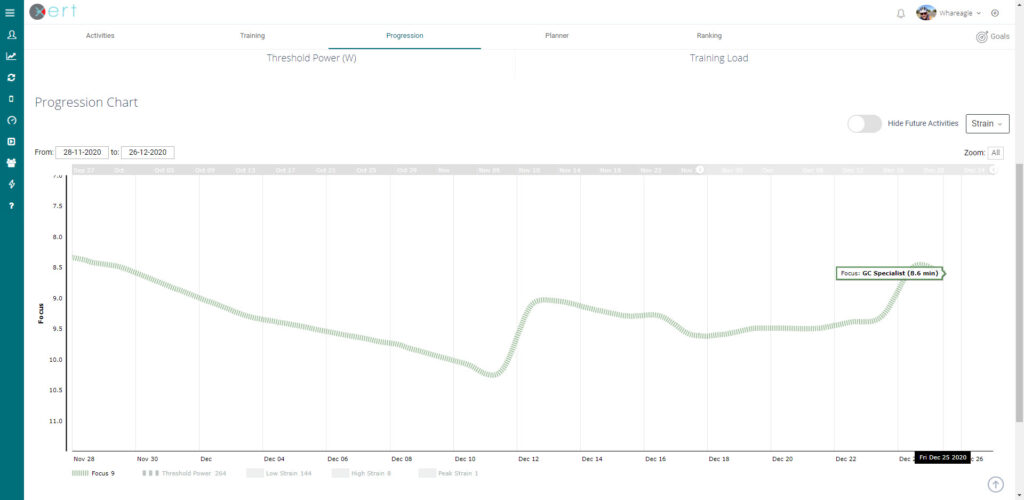
The Xert FOCUS feature is one of the best, but perhaps least-understood features in the Xert Fitness Ecosystem. The value is expressed in terms of “Time”, and on the Garmin Fields, it also includes Color, to describe whether a ride is Polarized, Mixed, or Pure.
The best way to define FOCUS is this: At the END OF A RIDE, if your FOCUS is, say, 8:00 minutes, then the “CONCENTRATION OF BENEFITS” for all the KiloJoules, Intensity, and Recovery, from that ride, led to the best gains in the “8 Minute” range of Mean Max Power.
If the FOCUS is BLACK, then the ride was decently “Polarized”. This means that the low intensity was nice and low, and made up a good percentage of the majority of that ride. The High Intensity was sufficiently High (above the 3 Minute Mean Max Power Value in your Power-Duration Curve), that it “Pulled” the FOCUS ‘UP’ (towards 0:00, which is infinitely hard).
If the FOCUS is BLUE, then the ride was “Mixed” in its’ Polarization. This means the ride had plenty of time in Tempo and Threshold wattages, as well as lower intensity and higher intensity power. BLUE is not a bad value. It’s just that it’s not “Polarized”.
IF the FOCUS is GREEN, then the ride was highly “Polarized”, with LOTS of time spent at low, aerobic power, and just a select period of time at those stratospheric intensities.
Finally, if the FOCUS is ORANGE, it’s almost certainly accompanied with a time that is BEYOND “60:00”, and is “Purely” Aerobic.
USING FOCUS AS PROGRESSION
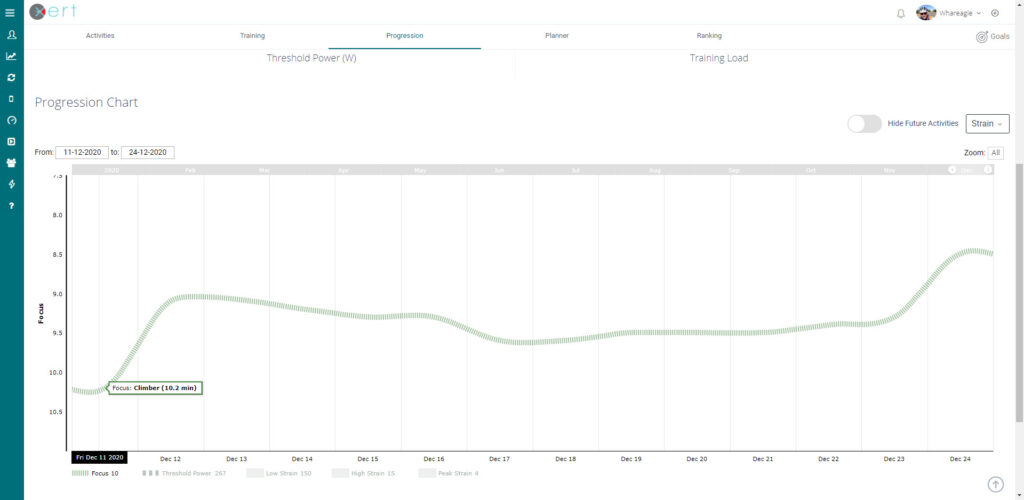
Here, I began my FOCUS at 10:00, and “grew” into a rolling 3-week FOCUS that is now at 8:30.
When I began this training block in late November of 2020, I set parameters inside of the “Goals” button, so that my overall volume was manageable, and my Improvement Rate was “SLOW”. This gave me an Estimated Weekly Training requirement between 5 and 8 hours per week. It is manageable, and since I am riding indoors, on rollers, the volume and intensity are something I can handle without loss of control of the bike.
What I did not realize was that in the “Build” phase, FOCUS would be the source of my Progression! Fascinating!
WHAT IS the F.I.T.T. Variable Principle?
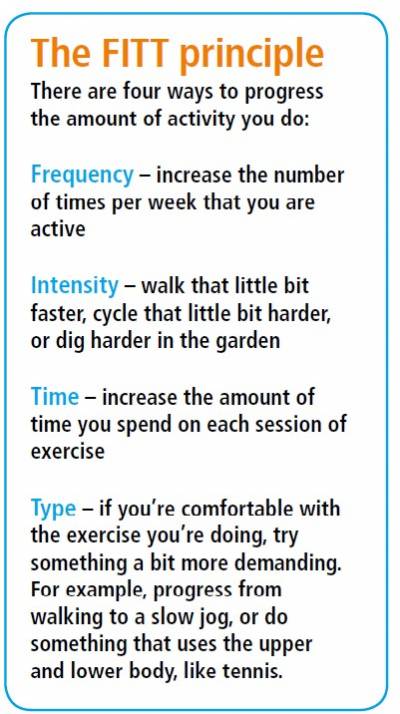
In the fitness world, F.I.T.T. is an acronym, which stands for:
- Frequency
- Intensity
- Time
- Type
Frequency means “How Many”. How many workouts per week? Should I do more intervals this session than last?
Intensity means “How Hard”. Should these Intervals be in Xert Orange, or Yellow? Maybe even red now and then?
Time translates into “How Long”. Should I perform a 60 or a 75 minute ride? Will the intervals be 30 seconds, 60 seconds, or 90 seconds?
My interpretation of “Type” for this purpose comes down to some simple themes: Is the ride ‘base’, ‘structured intervals’, or ‘Fartlek’?
The last three weeks, I have seen steady Progression in “FOCUS”, which means an increase in the “Intensity” of the rides.
Here are several examples, and I performed these efforts under the recommendations of the Xert Adaptive Training Advisor.
Xert FOCUS as Progression.
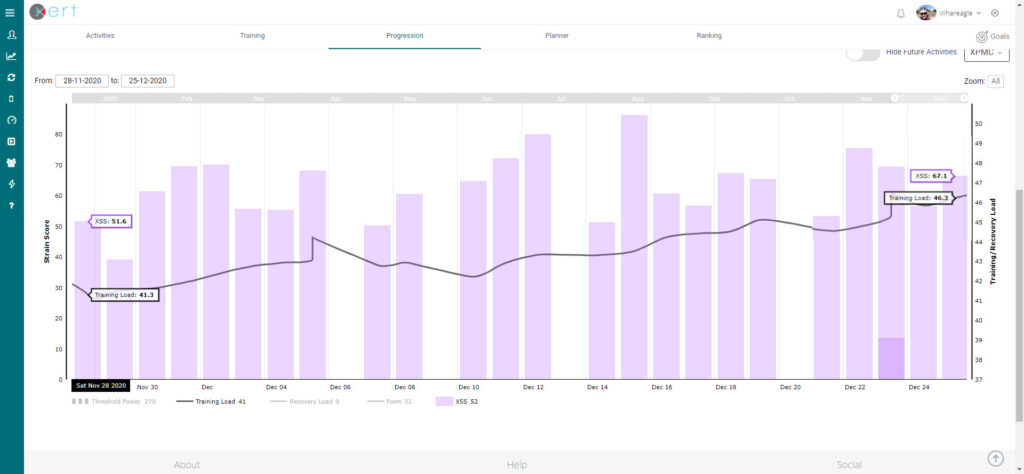
Here is a link to a ride I performed on November 30th, 2020. The ride was “PURE” Endurance. In other words, it was low-intensity, was purely aerobic, and burned a lot of fat for the effort.
Now, five days later, The Xert Adaptive Training Advisor gave me an Xert XSS and FOCUS goal that was in the 19:00 Range. Here’s the workout – Mission Accomplished!
By Tuesday the 8th of December, the XSS goals were still in the 50-70 point range, but the FOCUS had “Risen” (remember – lower numbers mean higher intensity), to Fifteen Minutes.
On Saturday, the 12th of December, Xert Stain Score remained manageable, but the Adaptive Training Advisor had my goal FOCUS at “12:00”. Here’s the workout.
So in just two weeks, FOCUS went from highly aerobic, to more intense. I was beginning to see just how the Xert Adaptive Training Advisor was using my data, to tune itself. Every time I accomplished the task, the Xert Training Pacer kept the needle between 11 and 1 o’clock, and it kept ‘pushing’ me to higher intensities via “FOCUS”.
On Thursday, December 17th, 2020, my FOCUS goal was in the 10:00 range.
By Tuesday, the 22nd of December, FOCUS goal was inside of 8:00.
Only around the time of Christmas Day, did the Xert Adaptive Training Advisor switch my FOCUS goal from Progressive to Periodized, moving my FOCUS “DOWN” and back to “Endurance”, or outside of the 1:00:00 mark. This also coincided with me “breaking” the recommendations, and performing some workouts that were more intense than the Advisor recommended. This was intentional – I was performing intervals with a Vo2 Master Gas Exchange Analyzer, to highlight its’ effectiveness when paired with another, fantastic piece of software that I use daily – PerfPro Studio.
CONCLUSION
The Xert Adaptive Training Advisor looks at a cyclist’s workout parameters, under “Frequency”, “Intensity”, and “Time”. Not everyone has 12 hours a week to commit to their training. No individual can be set to a concrete plan. Within the parameters of 5-8 hours of available time, and a “Slow” Improvement Rate, the Xert Adaptive Training Advisor set me up for Progression in the form of “FOCUS”, or “Intensity”. I was able to Fartlek my way through the rides while on my rollers, and achieve the daily and weekly goals the Advisor has set.
Next, I’ll discuss “Form” and “Fatigue” in the Xert Ecosystem, as that has everything to do with the XSS and FOCUS goals, and our adaptation to ever-increasing volume and intensity, however, slight.
One Response
Great… great post!!!