Ergometer Load based on % Threshold Might Earn More Time In the FatMax Zone
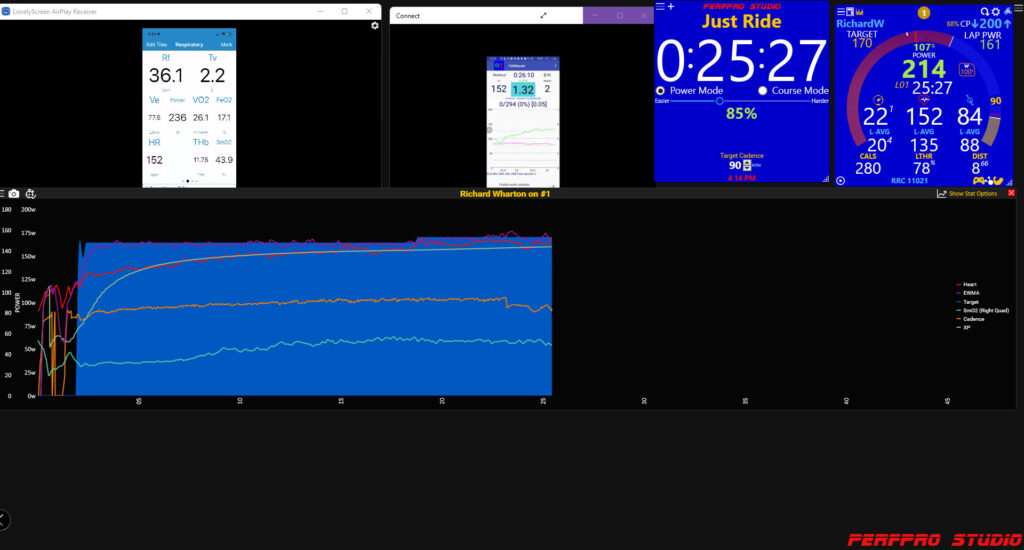
PerfPro Studio is such a fantastic product for training and analysis. It allows a cyclist to ride at a load based on an ergometer, or a load based on % slope. Yesterday, after assessing my DFAA-1 heart rate, SmO2 and wattage values, I decided to ‘test’ the values.
Under Dr. Bruce Rogers’ assessment, we decided that DFAA-1 at 0.75 occurred around 150 beats per minute, and DFAA-1 at 0.50 occurred around 165 beats per minute. Lower Threshold Power (DFAA-1 0.75) occurred around 166 watts, and Upper Threshold occurred around 196 watts.
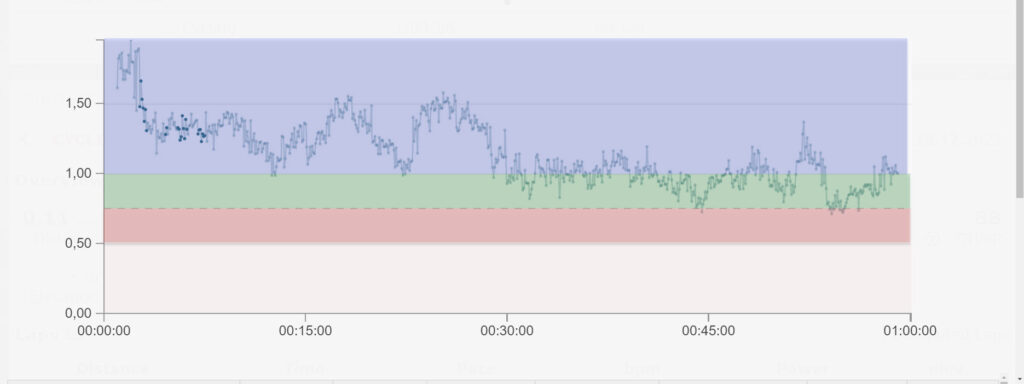
I began my ride yesterday by setting the ergometer at 164 watts, right around the 166 watts that would set me on my way to 0.75 DFAA. Ironically, my heart rate never rose above 144 beats per minute, and my DFAA-1 averaged about a 1.20.
Next, I raised the intensity to 170 watts on the Ergometer. Heart rate hit about 151 beats per minute, and DFAA-1 dipped down to about 0.89.
Finally, I raised intensity on the ergometer to 178 watts up to about 45 minutes, and DFAA-1 slowly dropped until it began to dip below 0.50. At that point, I backed off on the ergometer to about 172 watts, and DFAA-1 stayed right in the sweet spot, between 0.500 and 0.75 for the remainder of the hour.
The Difference Between Ergometer Mode and % Slope Mode
Back in the early days of indoor training, we had two separate modes of resistance. There was % slope, which set load based on how much work a cyclist was doing to overcome the friction of gravity. It was highly variable and required nuanced changes to cadence. The other mode, ergometer mode, placed a (Calibrated) load against the rear wheel.
Newton’s Third Law states: When a load is placed on an object, an equal and opposite load is placed against it.
That’s the foundation for ERG mode; the ergometer artificially placed 150 watts against the wheel, and it’s up to the cyclist to generate 150 watts to make the wheel move.
But it FEELS different. It’s not real. In fact, in many ways, it’s harder than slope mode, because the load is 360 degrees for each leg, unlike in the real world, where micro-inertia leads to varying loads (exacerbated by ovalized chainrings….). It’s not my favorite, but ergometer mode does have its’ purposes, like the workout described here.
Ergometer Mode Helped me ‘Tune’ my ride
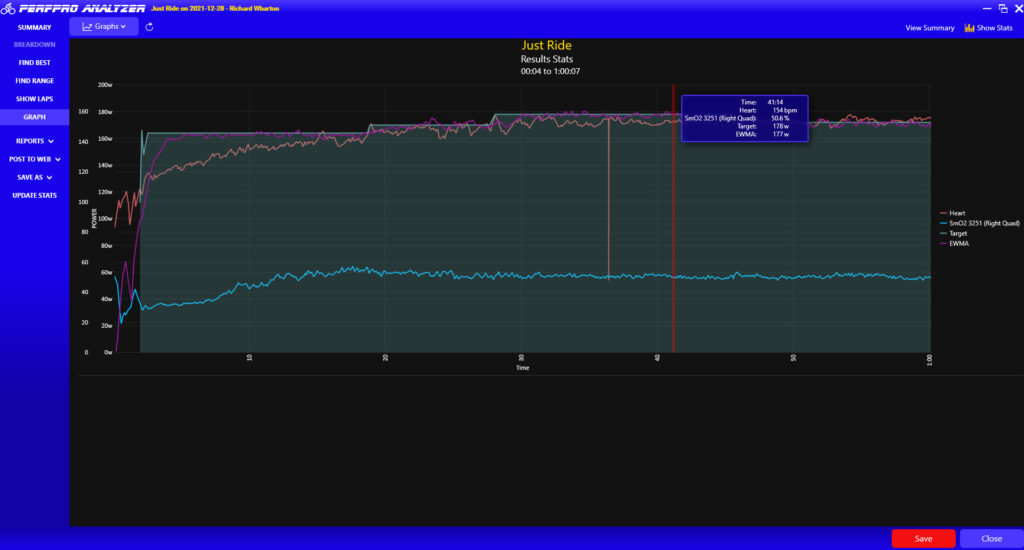
For the entire ride, my average power was 168 watts. Average SmO2 was a comfortable 48%. Average heart rate was 145 beats per minute. DFAA-1? About a 1.23, given how easy the effort was in the first half of the ride.
Here’s the important part; I used my indoor trainer in Ergometer Mode, to raise and lower intensity, and thus lower and raise DFAA-1 values, to hit my FatMaxxer sweet spot. EVERY DAY THOSE ERG LOADS WILL CHANGE! The heart has a heart. It reacts to sleep, diet, fatigue, hydration, and more. Some days yield high values, some days yield low values. Use DFAA-1 as the PRIMARY METRIC. Over Time, as I have shown before, the Average Power will trend UP. Average Heart Rate will TREND UP. If you want to lose weight, as power goes up, kilojoule count goes up, and inevitably, grams of fat use will rise as well. It may not be fun, but it is critical to Base Training.
Thanks for reading and ENJOY THE RIDE!