
2023: New Home, New Goals, New Services, New Discussions

New Home: Sacramento, California, USA! Hey everyone, I can’t believe that I’ve landed and set up shop in our new home here in Sacramento, California. Honestly, I haven’t been a Californian since 1974, so this is definitely going to be a new experience. Online Bike Coach has been a stalwart pillar of coaching and information […]
75 XSS For 75 Days – Six Weeks In
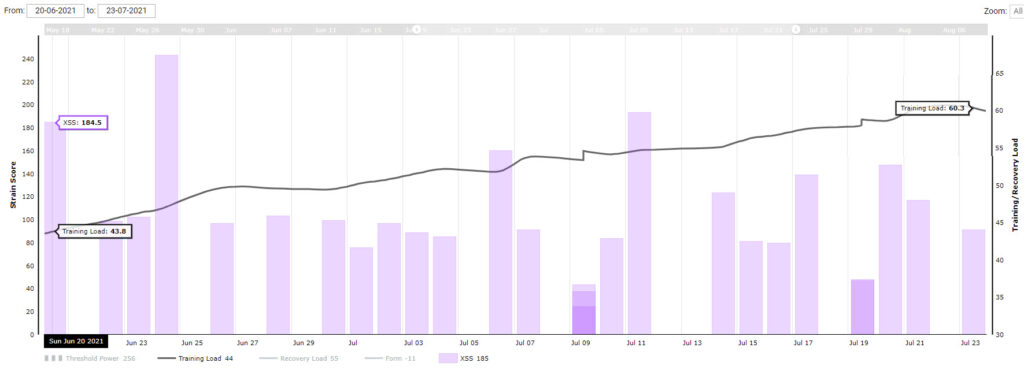
75 XSS As a Minimum Volume for a Ride Is Showing Some Results Achieving 75 XSS (Xert Strain Score) points for every ride is leading to some interesting results. While I thought I was being consistent, it’s been a challenge. Most weeks have gone in a “4 rides”, one day off, 3 rides, one day […]
75 XSS for 75 Days – 3 Weeks In.
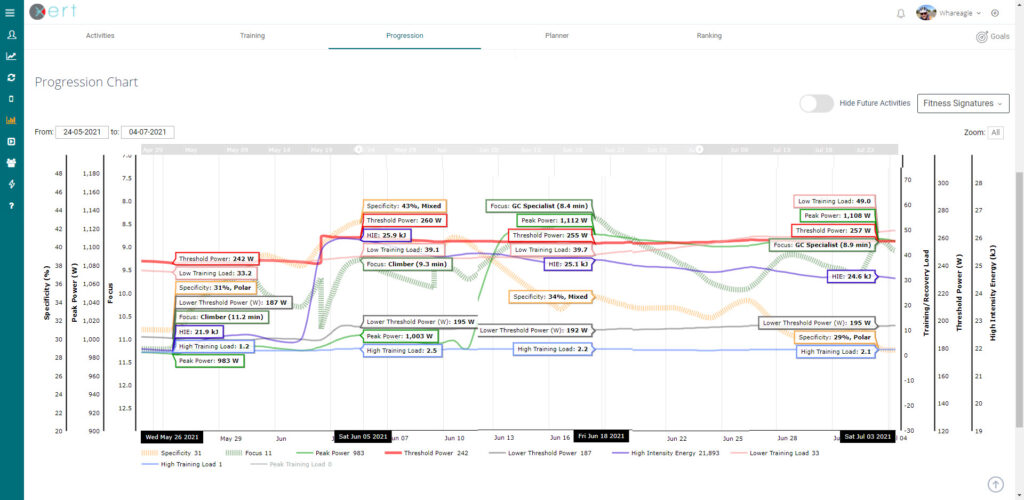
75 XSS Is Bringing me VOLUME, But What Else Am I Accomplishing? ***** THIS DID NOT PUBLISH ON JULY 4th, 2021 LIKE I EXPECTED. PLEASE EXCUSE THE TECHNICAL GLITCH. I AM WORKING ON AN END-OF-JULY REPORT NOW. ******* XSS (Xert Strain Score) is a metric that looks at the time you spend riding, the energy […]
75 XSS (Per Day), for 75 Days: A New Self-Challenge
75 Days of 75 XSS (Xert Strain Score) Points – Let’s See Where This Leads 75 XSS per day, roughly 5 days per week? Can I achieve this? The Xert Strain Score (XSS) is a volume-measuring tool that looks at a cyclist’s time, wattage, energy expenditure, and overall fitness signature. The calculation is unknown, but […]
Xert FTP Tested
Xert Claims my FTP (Functional Threshold Power) Sits At 265 Watts. Is It Accurate?
I’ve always wondered if calculated Functional Threshold Power Values are accurate. Since 2017, however, I have relied on the Xert FTP value.
For years, we relied on the “20-Minute” Test. Riders would perform a 20-Minute effort, all out, and then subtract 5% from that value. The new number was considered “Threshold”.
Later, physiologists looked at 90% of a 3-Minute Maximal Effort.
There’s the 5-1-5 test….
Step Tests (25w steps every 3 minutes)…
Ramp tests (15-20w every minute)…
The latest ‘Testing’ asks for a 20-minute, 5-minute, 1-minute, and 5-second effort.
[caption id="attachment_12832" align="aligncenter" width="1024"] Xert Claims that my FTP (Functional Threshold Power) is at 265 watts. Let’s find out how accurate that really is.[/caption]
NO MORE TESTING???.
Xert Breakthrough Programming
Xert Breakthrough Programming – Building a workout to achieve a breakthrough! Today I’m building a workout, first through Excel, then through the Xert Workout Builder, to create 5 by 1-minute intervals, to help me visualize the average power necessary to achieve a breakthrough. I’m trying to program surpassing 356 watts over 5 minutes. Here’s […]
OverReaching
OverReaching With Xert I’m just 10 days out from my “Peak” with the Xert Adaptive Training Advisor and Xert Goals, so it’s important that I push through this period, and OverReach. An OverReach is about increasing both training volume and intensity, and FOCUSING on the intervals necessary to improve, in this case, my 5MMP power […]
Xert Workouts
Xert Workouts Follow the “SMART” Protocol Today’s Xert Daily Ditty shows how important a good night’s rest can be, towards helping you continue your path of Progression. I slept over 8 hours last night. When I awoke, I adjusted the Xert “Freshness Feedback”, and then, using the new Xert Adaptive Training Advisor recommendations, built a […]
Xert Daily Ditty – Let’s GLANCE at the “Rankings”
Xert Rankings Give You An Idea of Where You Stand Amongst Your Peers After a great weekend of cycling outdoors, I ended up with an unexpected guest (and friends), which led me to a lot of stress and no sleep. SO, I am sliding the Freshness Feedback bar to the left, WAYYY Left, and […]
Xert Time-To-Exhaustion Field – PART 1.
[caption id="attachment_12608" align="aligncenter" width="282"]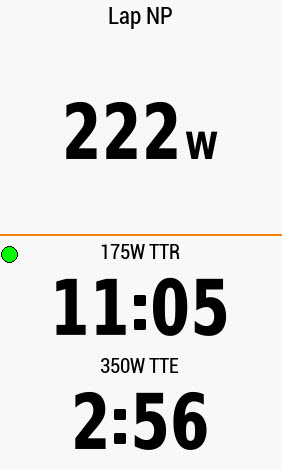 The Xert Time-To-Exhaustion Field is a very powerful tool for your training.[/caption]
The Xert Time-To-Exhaustion, Time-To-Recovery Field is one of the most powerful, yet least-understood or used Fields in the Xert Ecosystem. But when you use it correctly, it can be one of the most powerful tools on your Garmin head unit.
What Is the “Time-To-Exhaustion” Xert Field?
The Xert “Time-To-Exhaustion” Field (TTE) is a little-understood field that performs a couple of functions. It can be found in the Garmin Connect App Store.
Primarily, enter a known wattage in the “TTE” setup, and another known wattage in the “Time-To-Recovery” Field (TTR). Then install the Field on your Garmin Profile. When the phone syncs with the head unit, the field will populate two times. The “TTE” time will show how many minutes a seconds a cyclist has until their MPA (and High Intensity Energy – HIE) is exhausted, and the “TTR” will show how many minutes at a certain wattage are required for the athlete to recover.
Alternatively, there’s another setting. You can enter a known MPA as a “Floor”, and another known MPA as a “Ceiling”, Then, when you ride at ANY intensity, it will count down the time to reach that MPA, and then count down the time required to hit that MPA Ceiling for recovery.
This is a GREAT TOOL for a lot of reasons!