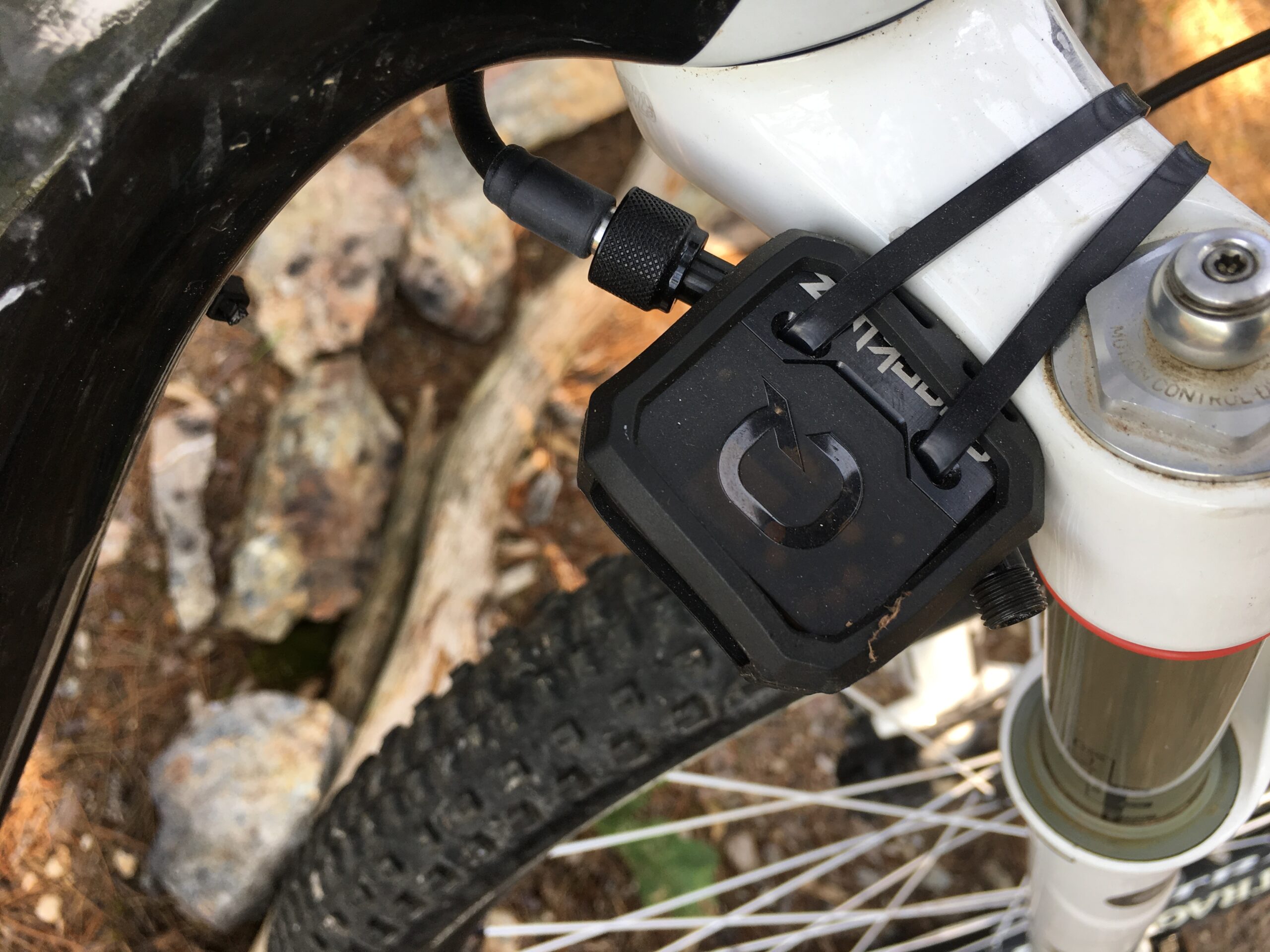
Air Pressure determines Sag and Compression, while the red ring sets rebound speed, and the black and blue dials help determine when the shock gets activated on bumps of different sizes.
Coach Wharton using a ShockWiz and a Power2Max to study mtb suspension on the Womble Trail in Arkansas.
Mountain biking; nothing makes me happier on a moment-to-moment basis than riding a mountain bike. Mountain biking is where I began cycling, and its' challenges continue to push me every time a throw a leg over and head down the trail. Mountain biking is fun, it's something I can do with my wife and with friends, and the technology just continues to impress me, as suspension, geometry, wheel diameter, gear options, and brake technology improves in such a quantum way.
My first mountain bike was all steel, had eight gears in the back, three up front, and no suspension. It also had 26" wheels. That was in 1987. The next year, I was riding a bike that was half-carbon, half-aluminum, had a 2.5 inch house-brand front suspension, and weighed 4 lbs. less. By 1995 I had purchased an early dual-suspension Trek Y-bike, and by the time I pretty much quit racing in 2001, I had a titanium frame with a soft-rear suspension, 3 inches of travel up front, and one of the first PowerTap MTB hubs ever built.
Coach Wharton's Trek SuperFly with Power2max, Shockwiz, and Garmin 1000.
Now, I'm riding a 2012 Trek SuperFly 100, with 4 inches of travel up front and in the rear, hydraulic disc brakes, two rings up front and ten in the rear. The wheels are 29 inches in diameter. THE NEXT YEAR, SRAM and then Shimano, introduced Single-Ring front drivetrains, 11 gears in the back, with broader ranges than I'd ever seen before. I think front and rear suspension gains a technology flip EVERY TWO YEARS! My own rig (and that of my wife), now has an OBSOLETE front and rear suspension system, a rear linkage system that has not been used since 2013, and the tires are 3/4 of an inch TOO NARROW.
It's incredible. Technology has literally transformed mountain biking. It's safer, faster, more comfortable, and higher performing than I've ever seen before.
BUT IT STILL TAKES SOMEONE WITH AN ENGINEERING DOCTORATE TO EXPLAIN SUSPENSION TO ME! AAAUUUGGHHH!
Shockwiz Suspension Tuner on a Front XC Sid Fork. Richard Wharton,
Enter the ShockWiz, by SRAM. It's two little boxes that mount to your frame and fork, and then attach to the compression air ports, where they measure impact, rebound, and all sorts of things that I just can't explain. I'll let it do the work.
The ShockWiz started out as a GoFundMe project, and is the brainchild of an Australian mountain biker. It started out around 2014, if I recall correctly, and ended up going to market after SRAM and Quarq saw the opportunity, bought the concept, and got it to the finish line. I was a fascinated early investor, but sadly, my opportunity to do some REAL mountain biking, is usually limited to 3 or 4 days a year. I don't compete, but when I'm out there, I love the challenge of every corner, every tree, every root, every rock garden, and every climb and descent. But I'm absolutely convinced that if I KNEW how to properly tune my suspension, I could improve my confidence, my competence, and the joy would compel me to do the simplest thing I can do - RIDE MORE OFTEN. I am convinced that the ShockWiz is doing that, right now.
Wombly Trail and Ouachita Lake, Highway 27, Arkansas
I'm writing this from a remote fishing village in Arkansas that sits along the famous "Wombly Trail". It's almost 40 miles of singletrack along the Ouachita River, and for me, it's Heaven! But it's also a PERFECT place to put the ShockWiz to use, and I did that today.
My 2012 SID Air was the first component to get the treatment, and it started with a roughly 15-minute calibration procedure that allowed the ShockWiz app to figure out my baselines. I used a shock pump to set the manufacturer's recommendations for the upper and lower chambers into the fork (as well as the rear shock), and then took off on my ride, with my wife not far behind. Over the course of the next twenty minutes, we rode, and when we pulled over for our first break, I consulted the app, which was reading the data behind-the-scenes, the entire time. It gave me recommendations for compression, rebound, ramp rate, preload.... all that stuff that is a mystery to me.
Read on (subscription required for this part) for a review of the initial recommendations...and step-by-step screencaps of how I worked through the process of getting the best suspension tune of my life.
First recommendations from Shockwiz.
Let’s break these down briefly.
Remove Baseline Air Pressure: I need to take some air out of the top of the fork, and go with some more sag.
Air Spring Ramp: Now, I’m not sure what this means, and I don’t think that my SID has spacers, but when I swipe on the right arrow, I get this….
I need to INCREASE the Air Spring Ramp. I’ll try doing this by adding air to the lower air chamber.
Rebound: I need to slow down the rebound on the fork – I can do this by adjusting a red dial on the bottom of the right-hand fork leg.
High Speed Compression: So that looks to be okay at first run….
Low Speed Compression: Here’s what the app says about this adjustment….
ShockWiz Low Speed Compression Suggestions. I can’t make too many changes all at once – I just have about 3 areas that I can manipulate on a fork, out in the field.
Bottom Out Resistance: Now, the ShockWiz is telling me to REMOVE Resistance, which means that, along with some of the other suggestions, I’m probably a little too stiff in my entire setup. Here’s the image showing suggestions.
Bottom Out Resistance Suggestions per Shockwiz. Again, I think I need to take air out of the top chamber, re-set the sag, and see how it goes.
Now – while this took a bit of explaining, the fact is that I was able to make adjustments OUT ON THE TRAIL, reset the app with the new air pressure information, and go back to riding. It all took maybe 5 minutes.
I repeated this many times over the next hour, and again the next day, all on the fork, to try and get the best mix of features. Finally, after a lot of “little tweaks” over the next day, I ended up with a result that looked like this:
Front Fork Score and Confidence Interval Summary after about 2 rides and maybe 6 different tweaks to the upper air chamber, lower air chamber, and rebound dial.
Notice how I got more “Green” bars over a couple of adjustments and rides?
In the end – I took out a few more psi on the upper chamber, and called it a success. My front fork was DEFINITELY absorbing more terrain, was steering better, and was just riding more comfortably on this course.
Always press the “Shock Travel” Rectangle after making adjustments. That will reset the value to between -3 and +3%.
It was time to move on to the Rear Suspension!
PART II – Dialing in the Rear Suspension.
Now, I’ve read my share of magazine articles, read numerous articles, and there are even some studies that were performed in the decade of the 00’s to try and determine whether hardtail mountain bikes were faster and more efficient than dual-suspension XC rigs, and if not, then by what percentage. But as the technology flips occurred, XC full-suspension bikes got lighter, faster, and more dependable, and they’re almost certainly the equals of hardtails, and in many cases, they’re superior. But dialing in the suspension is still critical, and I followed the recommendations of the folks at SRAM via ShockWiz, and worked on the rear suspension after the front suspension got dialed in.
***Just a quick note: If you look at the time stamp on the screen captures, that makes for a handy sort of progression timeline between readings and then alterations as I tuned both shocks.
ShockWiz Showed a relatively high score for a first ride. The “Shock Tuning Score” and “Confidence” value go hand-in-hand; you need to ride long enough, and gather enough data, that the confidence interval will rise above 50%, and a recommendation can be made. The score is based on ShockWiz’s empirical data for this ride. We’ll see what makes the score in the next screen.
Even though I got 84 points, it’s clear that there is a lot I can do to improve how my Rear Suspension works with my riding on this trail, at this speed and with this skillset.
Amazingly, the rear suspension seemed to operate pretty well along this section of the Wombly Trail.
One of the things I love about the software is that it shows my shock sag accurately. That way, I can use air pressure more precisely.
Now, again, I am bringing a “Beginner’s Mind” to this entire endeavour, and there are some settings for this shock which take some time to understand. Here’s a close-up of the shock rebound and “ProPedal” settings, all of which can be adjusted.
Air Pressure determines Sag and Compression, while the red ring sets rebound speed, and the black and blue dials help determine when the shock gets activated on bumps of different sizes.
I used my own interpretation of the initial results on the ShockWiz app, made some adjustments, and rode another trail segment to check results. Here’s what we got:
After making just a few adjustments, namely – taking out some air and then adjusting the red rebound ring, this was the score.
Looks like the only thing I need to focus on is the High Speed Compression, which I think is tuned via the Black and Blue Dials.
The Detections for the Rear Shock this run were all within spec.
Sag went down to 28%, and the shock moved much more, but I still never bottomed it out. I did feel that it altered the bike’s geometry somewhat.
To be honest – I was REALLY impressed with this one run, and after this, I left the rear suspension alone, declared victory, and began to focus on the trail and my ride, and using the Power2Max watt-meter, so I could determine just how well the bike rode with these new settings.
Another thing to consider; these settings were a BIG departure from the Trek Recommended settings. Those are available in a Trek archive, and I’m including them here:
These are the recommended settings for the RockShox SID, from Trek, via 2012. I ended up at 92 Psi and several more clicks slower. I also had more pressure in the lower fork than the upper.
And remember – for my rear suspension, the ShockWiz app recommended a 135psi, and I was I believe 9 clicks out, maybe more. OH – my entire ride tune was done with the ProPedal setting at the highest value, meaning it was the least likely to activate on bumps. The lower pressure made up for that.
NOW – let’s talk about the RIDE!!!!!
I’ve owned this bike for five years now, and under these new settings, using the ShockWiz recommendations….. I felt like it was a COMPLETELY different bike from the one I had originally purchased. Here’s a bullet list of impressions I felt….
It was a FAR smoother ride than I had ever experienced.
I was able to climb MUCH, MUCH, MUCH better – the rear suspension really gave me the ability to ‘grab’ the earth, and cover some terrain, seated, and with wattage in the high 400’s, at roughly 75-80 rpm, that I’m certain would have led to slipped tires, and a frustrating clip-out, then hike-a-bike. I noticed this several times. There were sections where I felt the rear suspension TRULY helped me pedal, without costing me lost energy. I think this is the most profound part of my application of the ShockWiz, and I can’t wait to explore that further.
On the front fork, it was also a much better experience – turns were handled with more confidence; the slower rebound settings led to zero pogoing, and as you know- a bicycle tire makes a poor rudder when suspended in the air. When I braked, compression was much better, and reaction was confidence-inspiring.
I descended faster (probably beyond my abilities), and relied more on the bike to soak up the roots, rocks, and dirt.
On hairpin singletrack, where there was a mountain on one side, and a cliff on the other, the suspension seemed to help make that one moment of indecisiveness pass safely.
In short – I COMPLETELY FELL IN LOVE WITH MOUNTAIN BIKING AGAIN! THANK YOU SHOCKWIZ!
I was IN CONTROL of my bike. The stiffness was gone, but the slushiness or sponginess I was expecting wasn’t there, either. It convinced me that I’d been doing something wrong – for a really, long time.
I’m going to take this rig to a local trail in Dallas this weekend, and I’m going to start this whole process over again, only this time, I’m going to record laps using my Power2Max and Garmin 1000. I think there’s a link between suspension optimization, power, energy output, and speed. I think the ShockWiz can be a critical element to delivering on that pillar, and the thing is; until Shockwiz, everything was pure CONJECTURE. Just take a look at the Trek recommendations vs. the values that I ended up using.
I still like a 2x ring because it gives me choices and range. Having a power meter may revolutionize the way we see and tune suspension.
I also think the Shockwiz can be used to tune a suspension for a specific trail or course. I know that in Texas, there are rocky courses, sandy courses, piney courses, rooted courses, flat courses, and each course has its’ own signature. Furthermore, each rider has signature strengths and weaknesses, on their bikes, on those courses, and if you’re willing to spend a day before an event just FIGURING OUT HOW TO OPTIMIZE YOUR SUSPENSION, it’s my belief that this will result in a higher speed for the same power output. Again, I’m speculating here, but with the P2M installed, and the Garmin 1000 recording, we SHOULD get a better idea of how everything comes together in synchrony, to enhance a rider’s performance.
Garmin 1000 Paired to a Power2Max MTB power meter.
I’ll report back next week, but if YOU are interested in the ShockWiz suspension system, or how wattage might be able to improve your performance when riding a mountain bike, I hope you’ll give me a call. For $200 we can spend a day at a trail with my sensors, looking, practicing, making changes, and optimizing your suspension system. I still have Ned Overend’s 1996 SRM file from a pre-ride of the Atlanta XC mtb course prior to the Olympics, and I’ve tried to study the demands of wattage for mountain bikers ever since. Who knows – maybe I’ll even get out there and race a little, myself?!
Thanks for reading.
Trail Riding on a Mountain bike is awesome. It’s even MORE fun when your suspension is dialed in!
Unlock the secrets to optimal recovery with Garmin’s Sleep Score! This metric simplifies your nightly rest into a score from 0 to 100, based on sleep duration and stages. Learn how elite athletes average a score of 74 and tailor your training from sleep trends. Whether cycling long distances or enhancing performance, understanding your sleep can make all the difference. Dive into insights that can transform your training!