SmO2 In A Non-Primary Muscle Reveals How Intervals Work
SmO2, or “Saturated Muscle Oxygen” is still one of my absolute favorite values when studying training. Most of this may seem anecdotal, but what I have seen since I began using the Moxy Muscle Oxygen Monitor in 2013 has been priceless. I learned how to Optimize a warmup. I learned how to look at SmO2 Peaks and Valleys. However, most of this information was done with the Moxy Monitor on my left or right Vastus Lateralis.
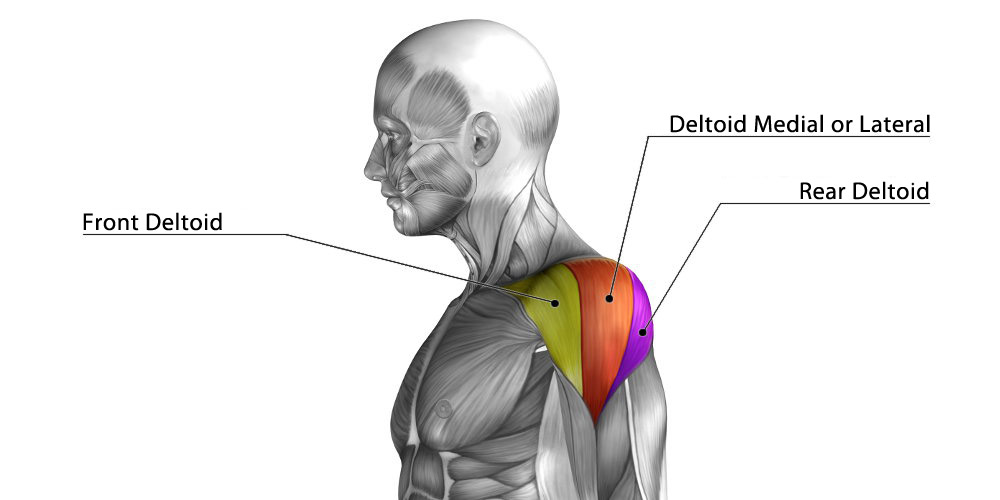
Under the tutelage of Coach Steve Neal, and later, Coach Andrew Sellars, I began looking at SmO2 data coming off of my Left Lateral Deltoid. Why would I use a Non-Prime Mover? Let’s see what’s going on.
Left Lateral Deltoid and SmO2
The Workout I performed this weekend was a set of 30-30’s. The protocol uses a warmup of 27 minutes, then 30 second intervals at about 120-140% of Threshold Wattage, followed by 30 seconds of Active Recovery, usually at around 150-170 watts. Now remember, this Journey to 300 watts is all about the INTRINSIC insights to be observed and reviewed, and not the EXTRINSIC rewards of Wattage at Threshold, Anaerobic Work Capacity values, etc. Those are nice, but they’re not the point. That WILL come, but not right now.
By placing a second Moxy Monitor on the Left Lateral Deltoid, per the coaches mentioned above, we are able to see the breakpoint at which the demand for oxygen in the bloodstream outstrips the body’s ability to process it back into energy or work to bring the body out of acidosis through the expiration of Co2 via the lungs. SmO2 values that dive in the Deltoid are physiological evidence that the body is under more stress than it can handle. THIS IS THE POINT OF INTERVALS! THEY INDUCE STRESS! The big difference is that now, this can be SEEN as well as FELT. Once we have a track record of these values, we can then determine how to TRAIN to DELAY this SmO2 dive, and ride at higher intensities while maintaining our ECONOMY!
Warm-Up Values
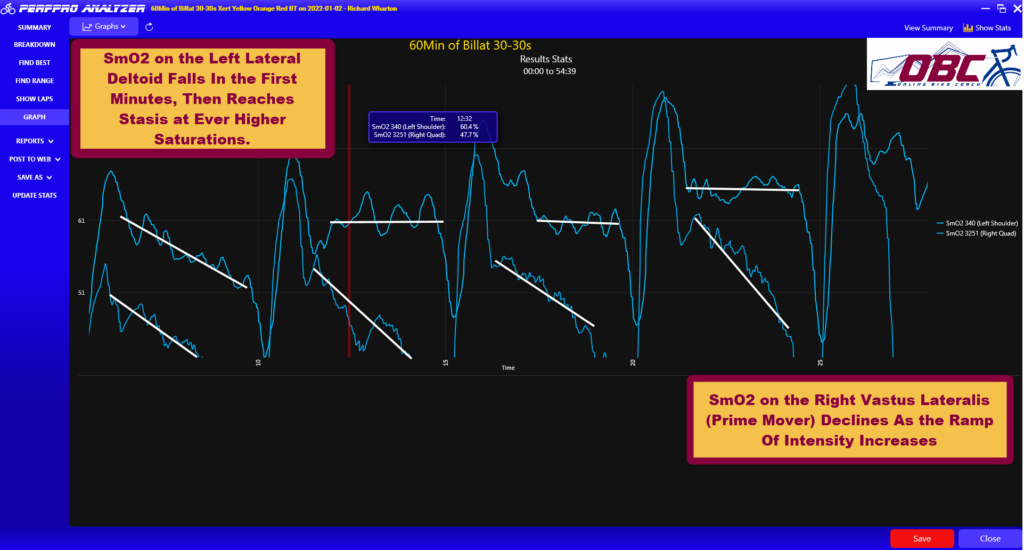
This is a chart from PerfPro Analyzer 2021 (Beta). PerfPro Analyzer continues to be my favorite workout and programming tool. It has the best display, the most customizable options, and Dr. Skiba’s Metrics are PUBLISHED and PEER REVIEWED. This cannot be said about other “Cycling Fitness” Platforms or their AstroTurf PhD’s. Remember, “In God We Trust, All Others Bring Objective, Peer-Reviewed, Published Data With Valid Hypotheses!”
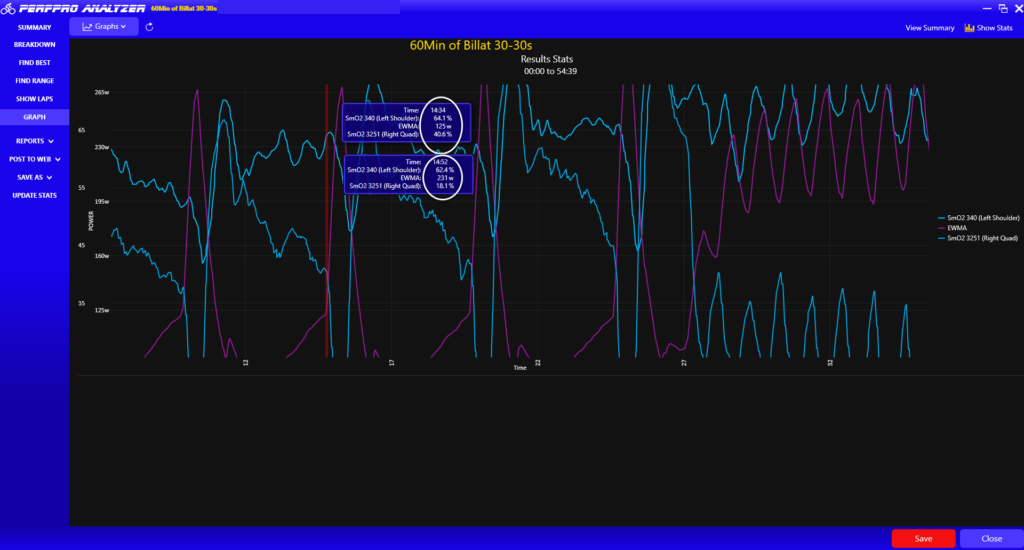
Specifically, look at the two lines on this graph. The Upper Line is my SmO2 value from a Moxy Monitor placed on my Left Lateral Deltoid. The Lower Line is an SmO2 Moxy Monitor placed on my Right Vastus Lateralis. This image is from my warmup.
The Upper Line shows Muscle Desaturation in the first interval that roughly parallels the muscle desaturation in the right leg. However, during and after each 30-second interval performed during the warmup, SmO2 for BOTH muscle groups DIVES, then REBOUNDS. In the 3 minutes and 30 seconds after each interval and recovery, SmO2 for the Left Lateral Deltoid PLATEAUS! Why? The Intensity of the Workout is BELOW THRESHOLD! The body is able to PROCESS the lactate that is always being generated by the legs!
Now let’s look at a close-up of the Deltoid and the Lateralis as I squeeze out a warmup interval.
CLOSE-UP
This is a zoomed-in look at the third warmup interval and recovery. Specifically, look at the Muscle Saturations for the TIME STAMP. The Interval’s average intensity is 357 watts, well above any theoretical Threshold Wattage or Critical Power. The SmO2 for the Right Lateralis drops immediately and significantly, below my zoomed-in area. However, 20 seconds into the 350+ watts, my Deltoid SmO2 is still stable. IT DOES drop after that, reaching its’ lowest point around 47%. It then rebounds up to 75%, and settles in again at around 62%.
CONCLUSION
I’m going to break this down into two posts, because I want to show how SmO2 in the Deltoid reacts to the 30-30’s, and how that works with the information I received from the Vo2master. The goal of any Billat workout is to accumulate more time ABOVE Threshold Vo2, and I want to show how that worked with the Left Lateral Deltoid as well as the Vo2master.
I’ll perform a more traditional 5-1-5 at some point to show the Left Deltoid, and we can come to some more conclusions over time.
Until then, thanks for reading, and ENJOY THE RIDE!