Fat Burning Is the Key to Longevity!

If you read the previous blog post, and watched the video, you know that we are going to use SCIENTIFIC INSTRUMENTS to glean fat-burning intensities for wattage, heart rate, Heart Rate Variability, and DFA-Alpha 1. DFA-Alpha1 translates into: “Detrended Fluctuation Analaysis”. It’s the intensity where your body happily burns fat as its’ primary source of energy. Over time and with chronic training, we can INCREASE our wattage output and heart rate for the same DFAA-1 values! We are no longer focusing on the HEART RATE VALUE ITSELF. That value will change with sleep, fatigue, medication, hydration, and diet. It’s too malleable. Instead, if we focus on the DFAA-1 values for EVERY BASE RIDE, we can get more bang per buck per minute, per ride!
Using Ventilatory Threshold (VT1), Lactate Threshold (LT1), and Muscle Oxygen slopes With DFAA-1
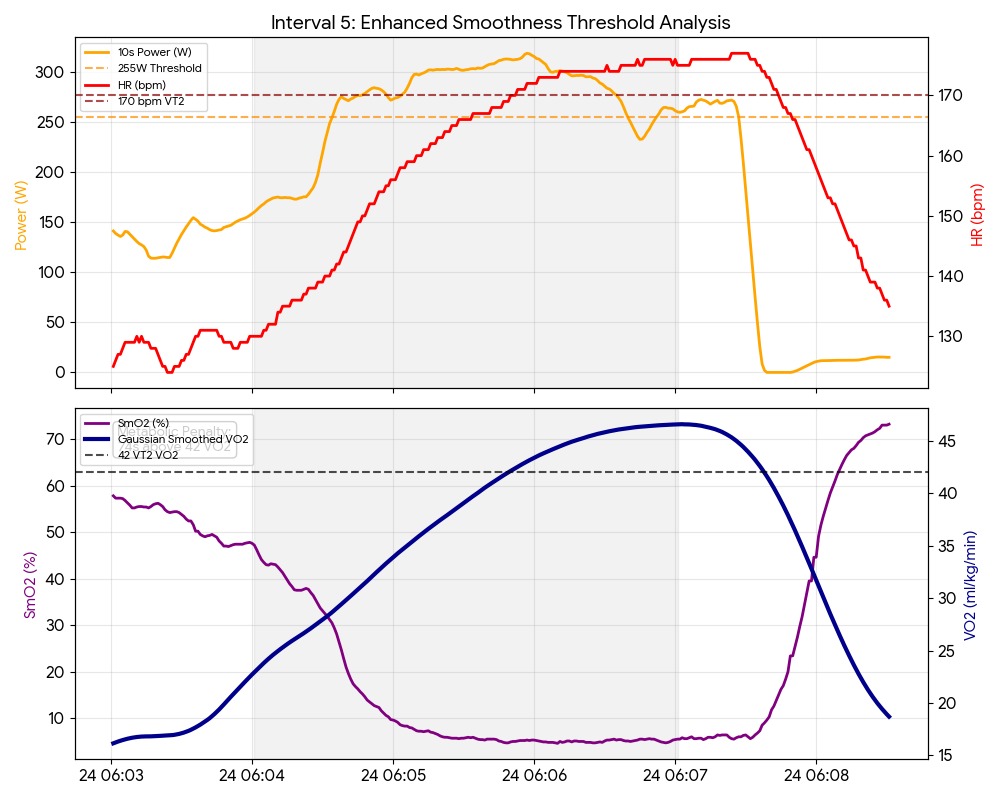
The metabolic fat-burning zone is not a new phenomenon. It can be found through a Vo2 apparatus that measures changes in Ventilatory Threshold. I can also find it through regular and invasive pricks with a Lactate Tester. The goal is to find the intensity where a cyclist’s Ventilatory Threshold changes; in other words, where their breathing frequency rises. We are trying to find the intensity where the body begins to accumulate Lactate from a point where it can be processed back into energy. The point where that blood lactate rises is known as LT1, and it SHOULD be similar to the area where VT1 also occurs. Finally, Muscle Oxygen values start to decline from a balance point when intensity rises. This intensity, when paired with SmO2 negative slopes over about 30-45 seconds, can also determine VT1, LT1, or what experts call “Breakpoint 1”.
But here’s the difference: Cost.
We Need to Find the Most Cost-Effective AND ACCURATE Way to Determine Fat Burning Zones
The instruments I use cost over $13,000 in 2021 value. They also usually require more than one person to conduct the assessment. DFAA-1 measurements, however, are both cost-effective, accurate, and can be used solo and on the bike, indoors and out. The Vo2master starts at $7500usd. A good power meter starts at $750usd. A muscle oxygen sensor is about $800usd.
A Polar H10 heart rate strap, with a FatMaxxer or HRV Logger app, costs less than $90usd…….
Therefore, DFAA-1 is the most cost-effective and timely method of determining Fat-Burning Zones.
Here’s a video explaining the upcoming base ride. I’ll post another video highlighting what we learned after it’s over.
Thanks for reading, thanks for watching, and ENJOY THE RIDE!